What should you check in a hyaluronic acid face cream? Explore formulation research, shopping questions and possible development alongside Dead Sea minerals.
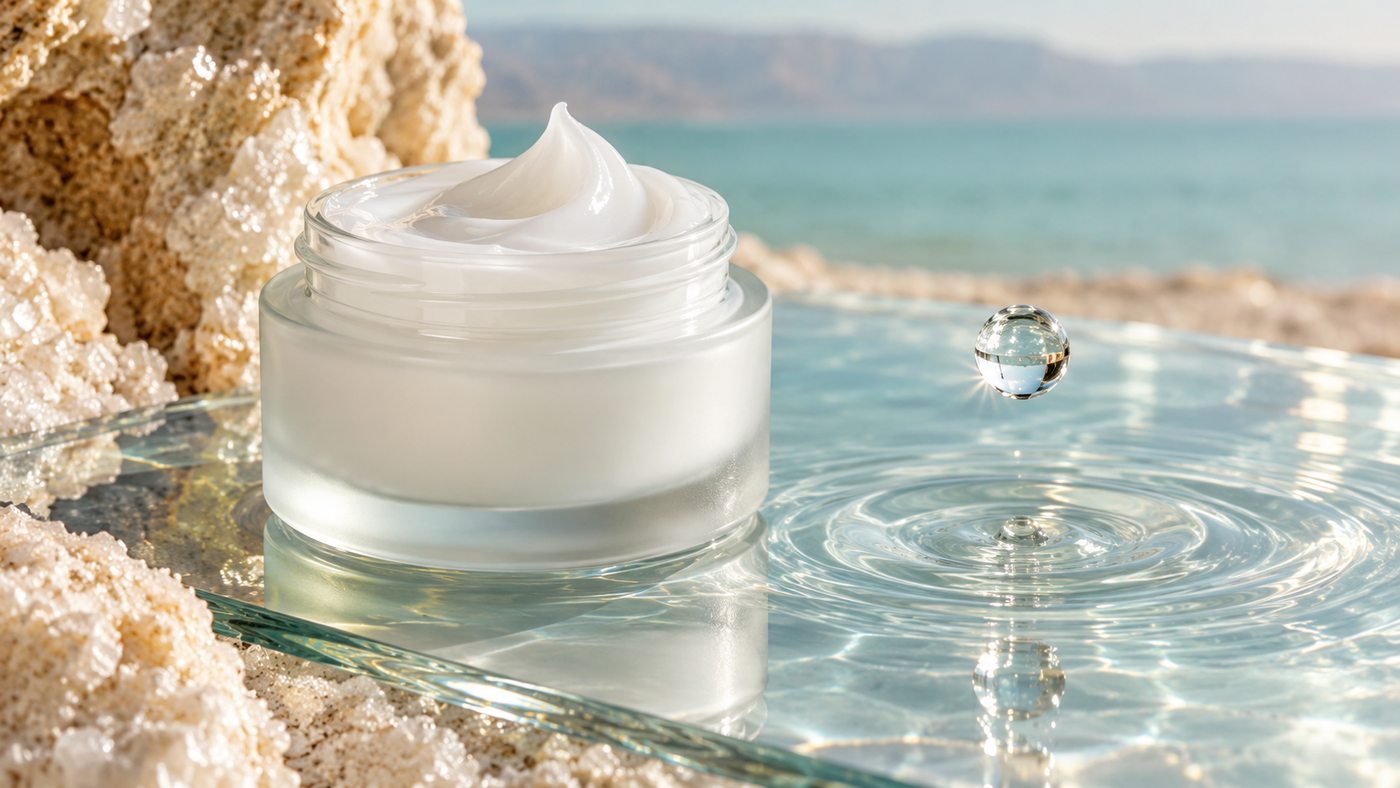
AI-generated conceptual illustration created for this article, not an image of a particular commercial product or laboratory.
Hyaluronic acid is associated with moisturising products, but the name on a jar is only the beginning. Choosing a cream means considering its purpose, directions and what is known about the whole formulation. The interesting future question is how to build a more purposeful, convenient product around the ingredient.
Hyaluronic acid appears in preparations for different applications, including topical use and injection. A shared ingredient name does not mean equivalent action. A hyaluronic cream is not an injected dermal filler, and should not be assumed to create the same volume effect as a medical procedure. [2]
A 2011 study evaluated creams containing 0.1% hyaluronic acid at different molecular weights in an anti-wrinkle investigation. Studying distinct formulations highlights the importance of the particular product. Its findings cannot automatically be transferred to every cream bearing the ingredient’s name. [1]
Ask what claims such as multiple forms of hyaluronic acid or high concentration actually mean. What is included in the stated percentage, and what tests were performed on the finished cream? Without that information, the headline does not enable a complete comparison. Texture preferences, compatibility with your routine and ease of use are also part of an individual choice.
It is possible to envisage a cream combining a hyaluronic ingredient with Dead Sea-derived components. That is a proposed development direction, not evidence of a superior combination. To evaluate it, we would want finished-product testing, a relevant comparison and a precise description of the outcome. Adding minerals alone should not be taken to establish deeper penetration or wrinkle filling.
Check the product description, current ingredient list and directions. If you already use a serum, another product is not required simply because it also contains hyaluronic acid. Choose around your routine rather than an injection-replacement promise. The shop lists skincare with hyaluronic ingredients in its descriptions; the research discussed here is not an efficacy test of those shop products.
The number alone is insufficient. Establish what it refers to and what was tested in the finished product.
No. Choose a product that fits your routine and its directions rather than duplicating ingredients because of packaging headlines.
Links lead to existing products for browsing. They do not imply that those products were tested in the cited studies.

A careful, practical explanation of salts and minerals in skincare, the skin bar…

What to expect from salt- and mud-based skincare alongside medical care, key pre…

Heel cracks get worse in summer because of sandals, dryness and pressure. A prac…

